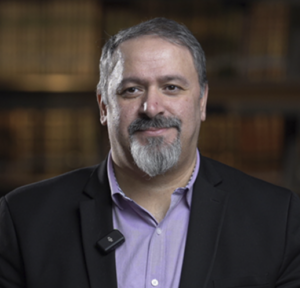
Younes Bensouda Mourri Discusses the Role of AI in Education on Ońtústik TV

When asked about AI’s role in supporting students with special needs, Younes highlighted its transformative potential for inclusive education. He explained how adaptive learning systems can adjust to each learner’s pace and challenges, ensuring that no student is left behind. For instance, AI-driven tools can provide sign language interpretationspeech recognition, or text-to-speech capabilities, allowing students with visual, auditory, or learning difficulties to access education on equal terms.

The discussion also touched on AI’s emotional and human dimensions. Younes noted that while AI can simulate certain emotional responses, true empathy and compassion remain inherently human traits, essential in education, healthcare, and communication. He underlined the importance of combining AI’s analytical power with human creativity, care, and critical thinking, ensuring technology enhances rather than replaces the human experience.

Addressing concerns that AI might reduce human intellectual effort, Younes compared this shift to historical innovations such as calculators or the Internet tools that initially raised skepticism but ultimately amplified human potential. He described AI as a “double-edged sword”: while it can accelerate progress, overreliance may hinder creativity if users fail to question or build upon AI’s outputs. Instead, he encouraged people to use AI as a partner for exploration, not as a substitute for thinking.

Younes also reflected on the evolution of AI technologies from early rule-based systems to the deep learning revolution that gave rise to transformer models like ChatGPT. He explained how continuous innovation and collaboration are leading toward a new era where AI systems communicate and build upon one another through shared frameworks like the Model Context Protocol, paving the way for more interconnected and context-aware AI ecosystems.

“AI’s value lies not in thinking for us, but in helping us think better.”
— Younes Bensouda Mourri, Founder of LiveTech.AI
Scroll to Top

Hari Seshasayee

Hari Seshasayee is co-founder of Consilium Group. A Latin Americanist from India and a graduate of Stanford University, Hari has a multifaceted experience with the region, having worked with think tanks, business associations, academia, corporates and governments – including with Gateway House, the Confederation of Indian Industry (CII), the Woodrow Wilson Center, Observer Research Foundation (ORF), ProColombia, the United Nations Development Programme (UNDP) and the Foreign Ministry of Panama. He previously led the Latin America desk at CII, where he organized the first India-Latin America Conclave held outside India, in Guadalajara, Mexico. At ProColombia, Hari managed a portfolio of trade worth more than $100 million across numerous sectors. He writes frequently and is often quoted by the media, including France24, BBC Mundo, CNN Español, Al Jazeera, the Los Angeles Times, Hindustan Times, the Times of India, Indian Express, Voz de América, among others. Hari has also contributed to journals and book chapters edited or published by Brookings Institution Press, Routledge, and the Inter-American Development Bank. He is also currently a Visiting Fellow at ORF and as Senior Fellow of the India Brazil Chamber of Commerce (IBCC). Hari has a Masters in Latin American Studies from Stanford University and a Bachelor of Mass Media from Mumbai University. He is fluent in English, Spanish, Tamil, Hindi, and speaks intermediate Portuguese.

Janaina Tewaney Mencomo

Janaina Tewaney Mencomo is co-founder of Consilium Group, and has vast experience working within Panama, the Latin American, South Asian and Pacific regions. She has also been appointed as a Member of the Advisory Council of the Latin American Faculty of Social Sciences (FLACSO) for the period of 2024-2028. She served at the Ministry of Commerce and Industries as one of the attorneys in charge of negotiating the Free Trade Agreement between Panama and the United States of America. At Strategic Foresight Group in Mumbai, India, she was an International Policy Analyst on terrorist financing, geopolitical scenario creation in security issues, and water diplomacy.In the Administration of President Laurentino Cortizo Cohen, she was appointed Minister of Government (Minister of the Interior), a position in which she launched the Economic Empowerment Plan for Indigenous Women, with the collaboration of the Inter-American Development Bank. In October 2022, she was appointed Minister of Foreign Affairs, a role that she performed till 2024, achieving a seat for Panama as a non-permanent member of the security council of United Nation. Janaina graduated in Law and Political Science at the University of Panama, obtained an advanced Master’s degree in International Law at the Universite Libre de Bruxelles, in Brusels, Belgium and a Master of Laws degree on Arbitration, Mediation and Dispute Resolution at the University of Hong Kong. Janaina is fluent in Spanish, English, French and speaks basic Hindi

Kader Laraichi

Kader Laraichi is an education and innovation leader supporting the development of AI-powered learning initiatives and education ecosystems in Morocco.

He works at the intersection of education, technology, and partnerships, contributing to initiatives that strengthen collaboration between institutions, startups, and public-sector stakeholders.

At LiveTech.AI, Kader supports ecosystem partnerships, innovation-driven education projects, and the adoption of advanced learning technologies aligned with Morocco’s education and digital transformation goals.

Ashraf Hamad​

Ashraf Hamad is the CEO of Numou Education, a Saudi-based education organization focused on localized learning systems, curriculum development, and institutional capacity building.

He brings extensive experience in education system design, localization, and leadership development, supporting institutions in aligning global best practices with Saudi educational and cultural contexts.

At LiveTech.AI, Ashraf leads regional localization efforts, institutional partnerships, and system-level education initiatives, ensuring solutions are culturally relevant, scalable, and aligned with national education goals.

Maytham Awachi

Maytham Awachi is a regional leader in education innovation and government partnerships across the Middle East. He works closely with ministries, public institutions, and education stakeholders to drive digital transformation and AI adoption in learning systems.

He is affiliated with Fahim AI, supporting the development and deployment of AI-powered education solutions that align with national education strategies and regional priorities.

At LiveTech.AI, Maytham focuses on building sustainable public-sector partnerships, enabling policy-aligned innovation, and supporting large-scale education modernization initiatives across the region.

Komal Ashraf Syed

Komal Ashraf Syed is a product and education leader specializing in edtech platforms, learning workflows, and large-scale technology delivery.

She holds an M.Ed. in Education from Harvard University, with prior academic training at LUMS.

At LiveTech.AI, she leads product strategy, partner integrations, and field deployment—translating pedagogical vision into reliable, scalable learning systems.

Carmen Nazario​

Carmen Nazario is a U.S. government and international partnerships leader with extensive experience in public-sector collaboration, education diplomacy, and institutional development.

She is a U.S. Army veteran and the President of ELYON International, where she leads strategic initiatives connecting governments, educational institutions, and international organizations.

Her work focuses on building sustainable government and education partnerships, supporting policy-driven programs, and enabling cross-sector collaboration at national and international levels.

Through her leadership, she has contributed to initiatives that strengthen institutional capacity, expand access to education, and support long-term development outcomes.

Aigerim Korzhumbayeva​

Aigerim Korzhumbayeva is an education scholar and EdTech expert specializing in learning design, teacher training, and AI-powered education systems.

She holds a PhD in Education from the University of Cambridge, a Master of Education from Harvard University, and a Bachelor’s degree from Stanford University.

Her work focuses on bridging pedagogy, technology, and institutional transformation, supporting education systems across Central Asia and international contexts.

At LiveTech.AI, she leads education strategy, curriculum development, and faculty partnerships, contributing to scalable and human-centered AI learning solutions.

Gabit Bekakhmetov

Gabit Bekakhmetov is a senior education leader and board member with extensive experience in higher education governance and institutional development in Kazakhstan.

He serves on the Board of Trustees of Maqsut Narikbayev University (MNU), contributing to strategic oversight, academic excellence, and international development initiatives.

Across his career, he has supported university modernization, global partnerships, and leadership frameworks that strengthen education systems and innovation ecosystems in Central Asia. 

Hon. Kilemi Mwiria

Hon. Kilemi Mwiria a Kenyan education leader, academic, and former public official with experience spanning higher education policy and national development. He served as a Member of Parliament and held government responsibilities in Kenya’s education sector, contributing to education policy development and reform initiatives.

He has also served as an education advisor at the national level and has been publicly associated with shaping education priorities and quality discussions in Kenya.

Across his work, he is known for bridging education strategy and implementation, supporting institutional strengthening, partnerships, and reforms that aim to improve access, outcomes, and system performance.

Younes Bensouda Mourri

Younes Bensouda Mourri is the Founder and CEO of LiveTech.AI, an education technology company focused on transforming learning systems through artificial intelligence, data analytics, and personalized education platforms.

A Stanford University alumnus and now lecturer, Younes combines deep technical expertise with strategic vision in AI, education reform, and digital transformation. He has advised ministries of education, public institutions, and private organizations across Africa, the Middle East, and Europe on large-scale education modernization initiatives.

His work focuses on adaptive learning, AI-driven analytics, and inclusive education systems designed to improve student outcomes, institutional efficiency, and long-term policy impact. Through LiveTech.AI, he leads the development of scalable solutions for schools, universities, and governments, helping bridge gaps in access, quality, and personalization in education.

Younes is recognized for his ability to translate advanced AI technologies into practical, ethical, and human-centered solutions that empower educators, learners, and decision-makers alike.

تخطَّ إلى المحتوى